I recently received a card from one of my managees saying:
For a sailor with just a wooden boat and a cloth, the sea is just a collection of water with some wind on top. However, few people realize that the more tools the sailor is given, the more complex the concept of the sea becomes. Tools should and could be helpful, but without the right guidance, the sailor will just become increasingly confused until he hates the sea rather than appreciating its complexity and the beauty therein. That is, unless the sailor is supported by a knowledgeable and dedicated captain.
~R
This card made me very happy because it shows I have improved. Last year, my thinking on managing people went from:
As a co-founder, I need to do this thing - manage people - and I have some intuition about it, but I feel mostly clueless and not interested, and it’s also draining.
to
I’m excited about management, and I have lessons that I’d like to put into practice and refine over time. I want to manage more people and spend more of my time doing it.
How did this change happen? Management hurdles, team turnover, and receiving coaching helped me see my management flaws and focus on what I need to improve. This led to a core insight: I shouldn’t mold my management based on some stylized practice. I should manage based on my style. Therefore, I revamped my management approach (or, rather, I thought about it properly for the first time). This made me excited.
I decided to write this blogpost to share some of my management lessons so that I can get feedback on them, commit myself to implementing them, and, perhaps, share some wisdom with existing and future managers. I’m saying it already: the point that I’m making is that you need to find your way to manage people. So, don’t just copy-paste the below into your practice.
A few disclaimers:
I never read management books. Make what you want from this.
I manage in this organization. This means that, often, I support people in navigating complexity, politics, uncertainty, group dynamics, and communication patterns. I suspect this might be a bit but not entirely different than if I were managing people in a tech start-up or a multinational.
I’ve been people’s first manager and people’s nth manager.
Project and people management intersect but are distinct practices. This blogpost focuses on people management.
I still feel quite ignorant about management, and I’m amused by the fact that this entire blogpost might just be rehearsing obvious facts about management and life.
I'll structure this post around five 'management mirrors'. First is the fundamental mirror - how management reflects (and should reflect) your authentic self. Second is the mirror of expectations, where manager and managee jointly assess performance. Third is a cautionary mirror, examining how managees sometimes mistake their performance for their identity. Fourth is the mirror of feedback, through which managers and managees help each other improve. Finally, I'll explore how your management style mirrors those who have managed you. The art of management lies not in perfectly polishing each mirror, but in learning to look into them honestly and helping others do the same. Let’s get started.
Your management should reflect your authentic self
I received leadership coaching and communication coaching. Both extensively focused on how to be a better manager. Both focused on one thing only: myself. We almost never talked about best practices, people’s expectations, social norms, etc. As much as managing people is about empowering others, the first thing to look at is your functioning.
For example, one of the bottlenecks in my management was how to be more firm. This was impeding me from giving feedback and, thus, from empowering my managees. Reasons why other people make giving feedback difficult are plenty. But they don’t matter. Instead, it’s possible to be firm with everyone the right way if you’re okay with being firm. By focusing on that, I uncovered patterns of mine, such as wanting to protect others, preserve our bonds, or reduce uncertainty for junior employees. Ultimately, I’d avoid giving feedback because it’d challenge the above. At the core of this pattern lies something deeper. My need for validation? My lack of self-love? My illusion of control? A combination of those. It’d have been very hard — for me at least — to get rid of this pattern if I didn’t work on the underlying drivers.
There are many other examples. And it’s also about management strengths. Fostering ambition and decisiveness in your managees might reflect your self-confidence. Having structured or unstructured management 1-1s might reflect your attachment to arbitrary rules. Identifying someone’s growth edges might result from your projections or your ability to be fully present with them.
So, the point here is that managing people will inevitably flow from what constitutes you. In the extreme case where you feel like you're managing "like in the textbooks" and entirely detached from your personality, this likely says something about how uncomfortable you are at following your intuitions. Following your intuitions doesn't mean being impulsive - it means trusting your accumulated experience and understanding of human dynamics, even when they don't fit neatly into management frameworks.
More importantly, your management style isn’t just a reflection of yourself. It should be. As you improve your management practices, it’s important to do this in a way that aligns with your flavors. Whether it’s a worldview, a communication style, some personal quirks, or some cold takes, bring them to your management. Inspire your management with what inspires you. This will not only make your management more effective (leveraging your strengths), but it will make it more unique and make you more relatable.
For example, one of my cold takes is that mere knowledge collection doesn’t suffice to achieve impact. It must be paired with action. I, therefore, push my managees to come to me not with information but with suggested courses of action. I ask them to come to me not with problems but with solutions to choose from.
The boundary between “what to understand in yourself to improve your management” and “what to leverage in yourself to manage people well” is fuzzy. If you’re naturally confrontational, there are instances where this is at your advantage and some where it’s detrimental to others and yourself. One rule of thumb to solve this is to make it a choice. If you follow something implicitly, you’re more likely to be compensating/replicating something. If you explicitly decide to do something, you’re more likely to do this because it’s good. So, boggle at the intersection of your personality and management (I recommend coaching), and make active decisions!
Below are some decisions I made that, I think, have strengthened my management so far.
Clear expectations create a shared mirror
It’s okay and important to be a demanding manager. Remember, as someone’s manager, you’re cultivating someone’s growth. Not being demanding literally implies thinking the person isn’t worth the effort. I prefer setting a high bar and treating people’s potential seriously.
Previously, I used to manage people by supporting them in their work but not communicating about what I think their growth edges were. As a result, every performance appraisal felt very ad hoc or post-rationalized. I switched and decided to specify and communicate what I think good performance is. Even if my understanding is limited, the existence of expectations is much better than the absence thereof.
Expressing expectations induces clarity. It sets goals for the person. It defines boundaries of what is to be addressed in this management relationship. And it defines a basis for performance reviews. Without expectations, a performance review will seem ad hoc, arbitrary, vague, and ultimately unfair to the managee. Expectations foster growth.
Now, in start-ups or young organizations like mine, it’s often unclear what expectations are. The people we hire come for entirely new roles. Often, it feels like I only discover my expectations for the person or the role after the fact. This is very suboptimal because the managee doesn’t know how they’re being evaluated, which may result in worse performance. The solution here is that it’s okay to change expectations over time (as long as they’re appropriately communicated). Changing them is key. Creating them from scratch and with little communication is much more complicated.
This begs the question: how do you know your expectations for your managee?
An obvious starting point is the person’s role description (if it even exists). Does the person fulfil their duties? Are they covering more of their role over time? Is the role changing and is the person engaging with these changes?
Role-based expectations might seem the clearest because they’re the basis of an employment contract. As in, it benefits from both parties’ signatures and presupposed shared understanding. The reality is that role-based expectations can be extremely fuzzy (“develop policy recommendations” = ?, “work with the team = ?”), often too large (to be evaluated on longer intervals than weeks or months), focused on tasks but not on behaviors or learning, and not adaptive enough to reflect someone’s growth.
To identify more relevant expectations, I recommend flow writing your answers to the following questions:
What are you taking for granted in this person’s performance? Spell out even the most mundane things. What’s obvious to you isn’t to others.
Simulate your disappointment with the person. What happened? Spell out and distil expectations.
What do you think is (and should be) in this person’s control? Spell out why.
The above is helpful to get started. As your management relationship evolves over time, you’ll need to shift to relative assessments. For example, through the following questions:
Based on the last quarter’s performance, what are the person’s growth edges moving forward and why are they important for the organization?
What are things that the person can do more, less, stop or start?
Based on previous quarters and the speed at which the person learns, what amount of time should they spend on improving on what?
There are many other questions you could ask yourselves to distil recommendations.
Now, identifying your expectations is one thing. It is useless if you don’t build a shared understanding of them with your managee. So, next, and regularly, spend time with your managee on building a shared understanding of those expectations. In that process, refine the expectations based on the person’s input.
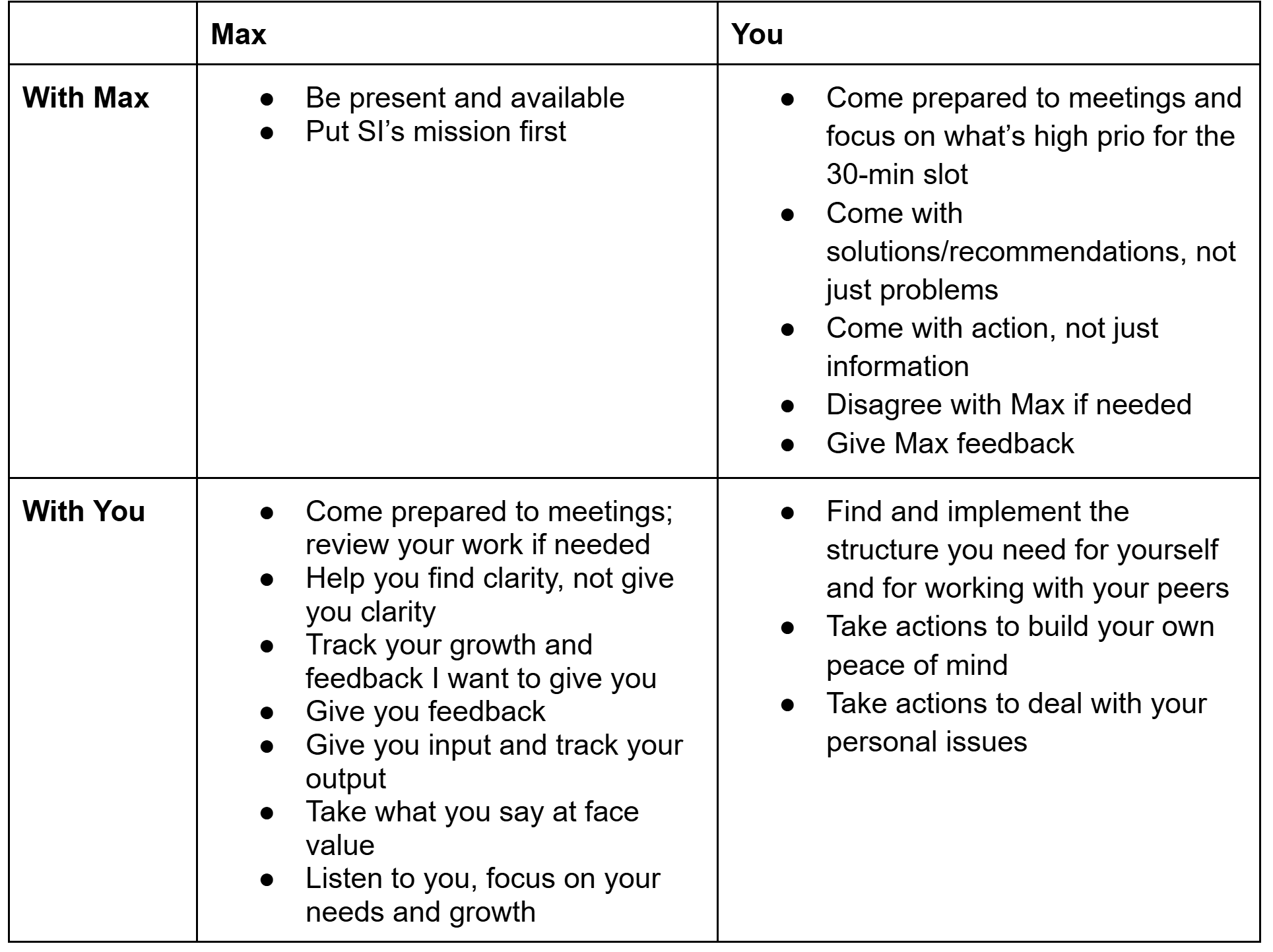
As you think about it and discuss with your managees, you’ll realize that there are different types of expectations. I found it very helpful to specify expectations in these four clusters:
Managee with themselves: e.g., ensure adequate work-life balance
Managee with manager: e.g., come prepared to 1-1 management meeting
Manager with managee: e.g., listen and support managee’s growth
Manager with themselves: e.g., manage for the benefit of the org’s mission
I found these categories helpful because we often specify expectations about the person’s work (is the person performing well?), but we neglect expectations about the relationship. Or, we focus on managee-manager expectations (and vice-versa), but neglect expectations both need to have with themselves. On that latter point, I realized that I have expectations that I want my managee to uphold for themselves (e.g., taking care of themselves). The system above allows me to express those expectations, responsibilize them, and draw the boundary that I won’t intervene in their personal life.
As an example of spelling out expectations, here is what I give and discuss with all my managees. Expectations over time are specified as part of performance reviews (every 6 months).
I (Max) care about fostering clarity, agency and efficiency in my management. My management will focus on helping you achieve excellent performance and growth. I want our relationship to be clear and yield clarity to both of us, boost your agency, and ensure we spend time on what’s necessary. Also, I’m sure we will have a lot of fun!
Our management is structured as follows. You can read more about it in our HR policy.
Weekly, 30-min 1-1, based on template
1x/quarter, retrospective + career development 60-min 1-1
2x/year, 360° performance review + 60-min meeting
Below is a matrix of intentions, expectations and commitments for ourselves and between each other. What’s written there is the default basis I implement with all my managees. I have thought and decided on these items because I think they will help you achieve the highest performance. The four quadrants also help specify what we can do just with ourselves: even if we will not check on these things during our conversations, they are part of what the expectations we set for ourselves. We will go through each point to make sure we have the same understanding. You’re welcome to add (not remove) points. We can update the matrix as we progress in our management relationship.
Communicating expectations is about helping managees know your bar. It introduces a basis to evaluate performance, terms of interaction and a shared understanding of boundaries. Expectations go both ways: managees should have expectations for their managers. Changing expectations is fine and desirable. Effective communication and feedback are key to going through those changes.
Performance isn’t identity — break the mirror
Expectations define the frame in which you and your managee operate as well as the goals to achieve together. The counterpart instrument to expectations is feedback, i.e., giving information so that you and your managee can correct-course to fit or refine the frame and achieve or adjust the goals. If frame+feedback go well, performance is high. And vice-versa.
However, I see a recurring tension in this process.
Picture this scenario: A brilliant, values-driven employee joins your team. They're passionate about the mission and pour themselves into their work. Their early successes fuel their motivation further. Then comes the inevitable moment – you need to give them constructive feedback. Suddenly, what should be a straightforward growth conversation becomes charged with emotion. They take the feedback personally, their confidence wavers, and their performance actually declines.
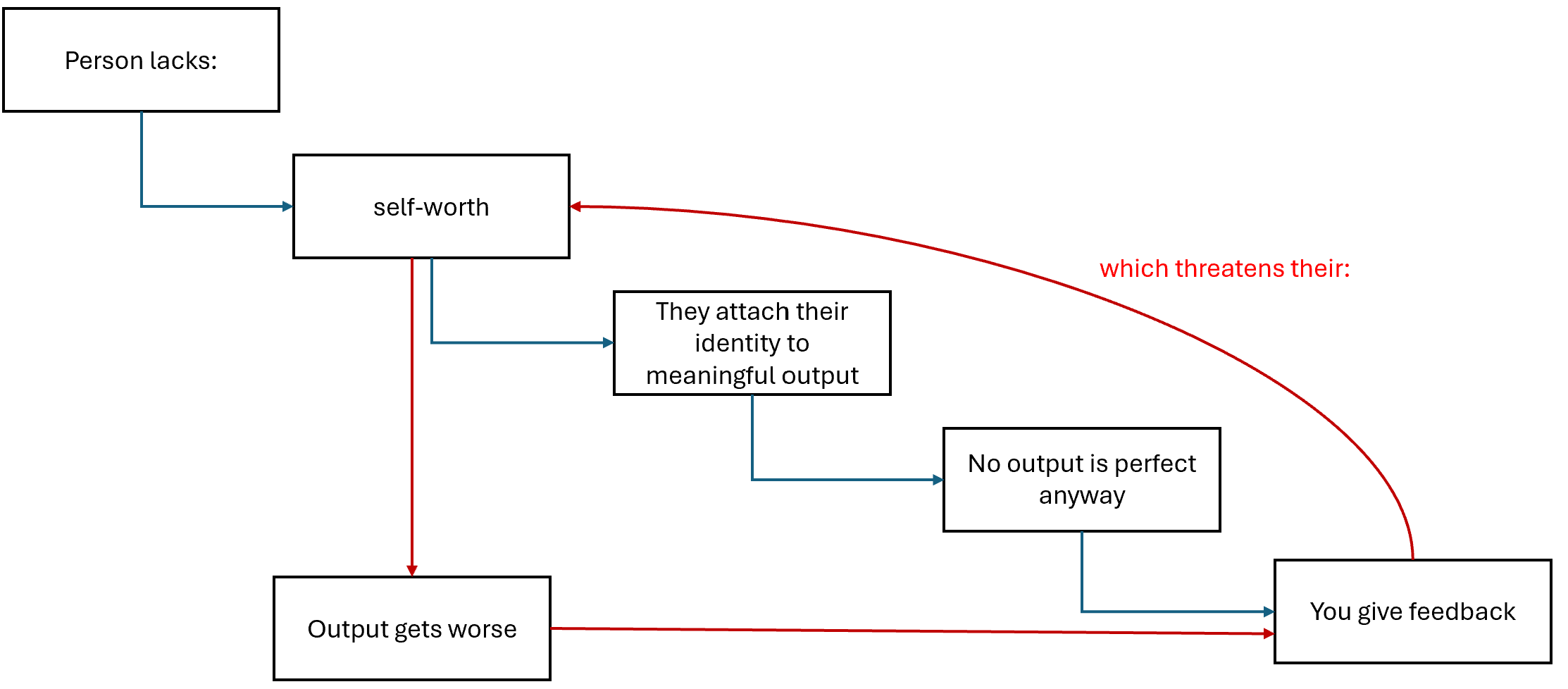
In my experience, 60-80% of people in my field fall into this pattern: intelligent, values-driven individuals who turn their work into a selfless vocation. While all ingredients for productive collaboration are present, their tight coupling of self-worth to work transforms feedback into an existential threat. This triggers a defensive spiral where constructive feedback becomes increasingly difficult as the person grows more self-conscious about their work.
It’s important to understand the following distinction: someone’s work can show their values, skills, and growth. But someone’s work cannot determine their inherent worth, fundamental identity, or full potential. Self-worth is there anyway, doesn’t go away, and doesn’t grow through work. It exists because the person lives through meaningful experiences.
This isn't just philosophical – it's practical, too. When people separate performance from identity, they handle feedback more constructively, can take more risks, learn from failures better, and also maintain a better work-life balance.
It is people’s responsibility to break this work-identity link. As a manager, it is your responsibility to remind them to do it.
How to handle this? I see at least two ways.
First, remind them of it. I decided to state it upfront and talk about it right away so that we can go back to it, rather than needing to clarify it for the first time once the feedback hurts. I added this paragraph to the expectations section in my management document.
If I were to pick one pattern I observe by working with people in the past 10 years is the following. When people tie their work too much to their self-worth, their performance worsens and they handle feedback much less constructively (my hunch: because questioning their work directly questions their persona and hence makes them feel unsafe). Therefore, I want you to be aware of this. I will be watching out for this and reminding you that you are not your work.
Second, don’t bother with it too much. Still give feedback. Repetition of feedback experiences will break the link. The person will learn to see their work being challenged but remain intact. Repeating as many loops of this as possible is important.
Feedback — the mirror of performance
For a long time, I worked with a narrative in my head “People need feedback. Managers give feedback. I should give feedback.”. And I had tons of conversations about what good feedback is. Should the feedback challenge or validate first? Should feedback be given instantly, privately, or during “feedback moments”? Should I reward verbs or adjectives? Should I raise issues or suggest actions? Should I be specific and give examples or primarily flag general patterns? As much as best practices are useful, despite knowing them, I rarely gave feedback to my team.
So, in this fourth section, my rule of thumb is to increase feedback quantity, not quality. I expect that giving more feedback will naturally make you better at giving it. If you already give a lot of feedback and it’s backfiring, then, for now, I think it’s either because you’re approaching something badly and have personal blindspots (first section), you haven’t communicated expectations or done so properly (second section), or your managee hasn’t gotten rid of an unhelpful link and you haven’t helped them do that (third section).
Increasing feedback quantity is useful for at least three reasons.
Feedback is information. If you don’t give it, you deprive your managee from accessing this information. Even imperfect feedback gives people more to work with than silence. Plus, regular feedback reduces its emotional weight.
More feedback creates more comfort. Giving more feedback more frequently builds confidence on your end and cultivates your managee’s ability to process it. More feedback helps normalize it as a standard practice rather than making it a surprise or an out-of-the-ordinary moment. And more feedback volume leads to a variety of approaches and content.
More feedback means more practice. By giving more feedback you begin to understand your authentic feedback style. You learn what works for different people. And you build muscle memory for difficult conversations.
Still. All of this is easier said than done. So, I suggest putting systems in place. I implemented two systems: one I use on my own, and one I use with my managees.
First, the system I use on my own is a daily + weekly log. Every day, I log my raw observations about my managees. I don’t filter those observations. I just list what I notice. And when I see something salient — positive or negative — I try to distil key feedback points. I also do that about myself.
Every week, in the same log, I give a score to my managee based how happy I am to pay their salary this week, where 1 is unhappy, 2 is somewhat happy, and 3 is satisfied. I then look at the feedback I collected and answer whether I’ve given this feedback or not. If not, I plan a moment when I will give it.
Finally, every week, I ask myself: Did I enable people to score 3? Was I clear enough for people to be a 3? If the person is 1 or 2: is there something I should have done, asked or provided?
This is what the log looks like. Pretty simple. And so far effective.
Second, the system I use with others combines written check-ins and a log of discussion and feedback points. The written check-in allows us to tackle things asynchronously and distil key points from it. This ensures management meetings focus on what’s most important. Otherwise, there is a risk they focus on the usual, mundane task-related questions instead of key decisions or feedback points.
This is the asynchronous check-in, filled by my managee and reviewed by me before every management meeting. The red row is to review the previous week. The green row is to plan the upcoming week.
And this is the table to prepare the meeting agenda, with dedicated space for two-way feedback.
To conclude, a manager is also a managee.
In most cases, a manager is also a managee. Whether being part of an endless hierarchy, held accountable by a board, or supported by a coach, a friend, or a mom. This means that all of the above is part of your own performance and can be explored together with the help of others.
As a managee, you learn how different management styles feel, what makes feedback land or miss, how expectations shape motivation, and when support helps or hinders. I used to have absent managers, harsh managers, and very supportive managers. They’ve all been sources of valuable things I try to replicate, avoid, or improve in my management. This parallel experience creates a continuous feedback loop for improving your management practice.
Like a house of mirrors, management reflects in multiple directions: inward as a reflection of yourself, outward in the expectations you set, downward in the feedback you give, and upward in how you process being managed. Each reflection offers a different perspective, a different lesson.
Now, the last mirror is you, dear reader. I’d be very grateful if you were to give me feedback on my current reflections.
I thank Suad, Carlos, and Ram for their feedback as well as all my previous and current managees and managers who have shaped my thinking on this subject.
Interesting! I wonder: what have you learned from your managees? What are your current growth edges wrt. management? How do you plan to work on them, and how are your managers and managees helping with them?
About finding your way of managing people, though out of scope: I have been making a similar claim about the fact that letting more women become managers is hard because the style will be significantly different from what people are used to from men - probably mostly because of social constructs and how genders are differentially raised. It’s harder for a woman to find their style because they have fewer examples to draw from, most probably because fewer people are of a style they can identify with. So there’s more to construct.






Interesting! I wonder: what have you learned from your managees? What are your current growth edges wrt. management? How do you plan to work on them, and how are your managers and managees helping with them?
About finding your way of managing people, though out of scope: I have been making a similar claim about the fact that letting more women become managers is hard because the style will be significantly different from what people are used to from men - probably mostly because of social constructs and how genders are differentially raised. It’s harder for a woman to find their style because they have fewer examples to draw from, most probably because fewer people are of a style they can identify with. So there’s more to construct.